How to Read a Balance Sheet for Stock Analysis
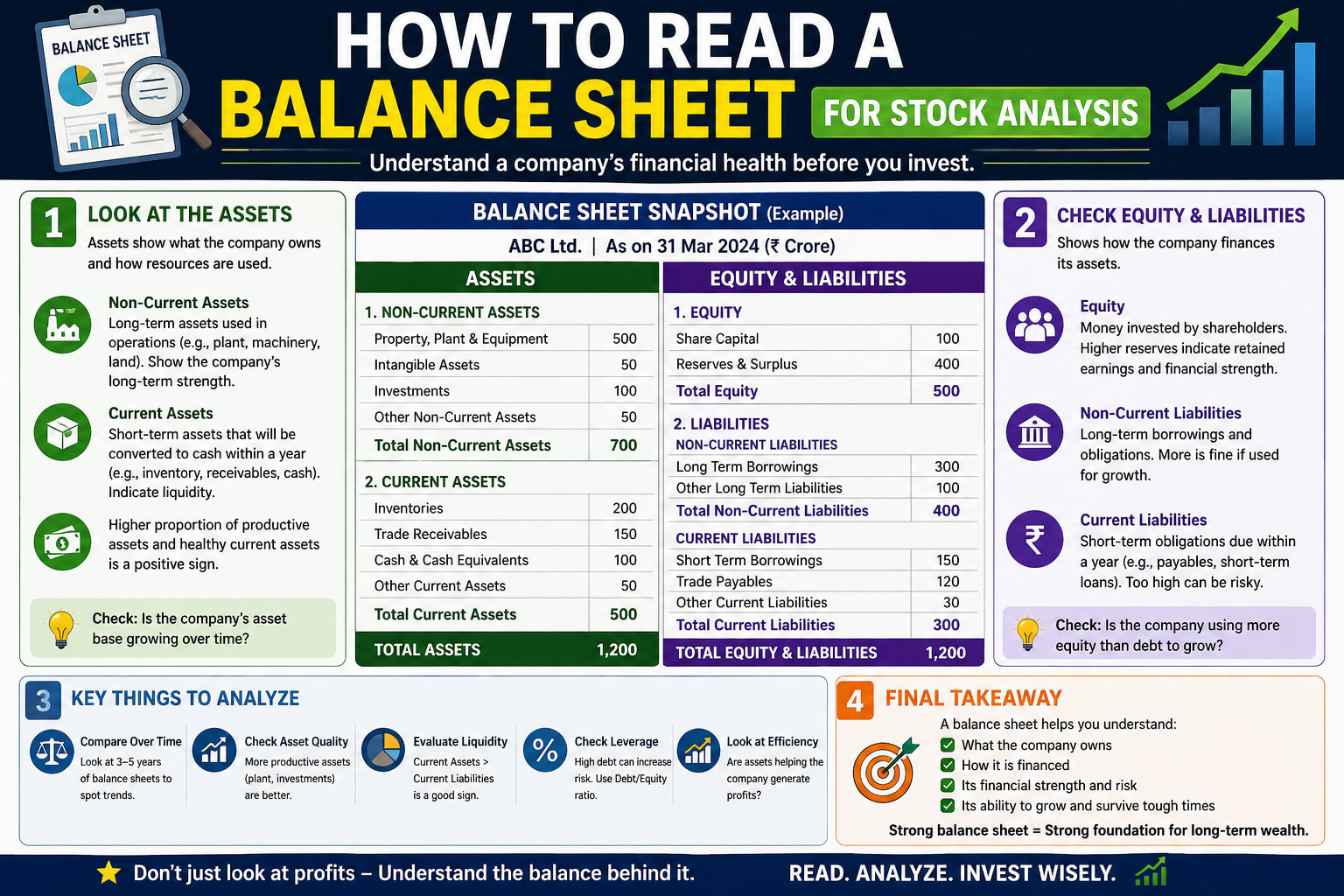
How to Read a Balance Sheet for Stock Analysis
A deep, practical guide to reading a balance sheet for stock analysis, including assets, liabilities, equity, debt, working capital, warning signs, and what investors should actually focus on.
Table of Contents
What Is a Balance Sheet in Stock Analysis?
A balance sheet is one of the three core financial statements, along with the profit and loss statement and the cash-flow statement. It shows what a company owns, what it owes, and what belongs to shareholders at a particular point in time. If the profit and loss statement tells you what happened during the year, the balance sheet tells you what the company looks like on the reporting date.
For stock analysis, this matters because many businesses can show impressive sales growth or earnings growth while their balance sheets quietly deteriorate. A weak balance sheet can destroy a stock story faster than a weak quarter. That is why serious investors never stop at revenue and profit alone.
The Three Main Parts of a Balance Sheet
| Section | What it includes | Why it matters for investors |
|---|---|---|
| Assets | Cash, receivables, inventory, property, investments, intangible assets | Shows what the company controls and where capital is tied up |
| Liabilities | Borrowings, payables, short-term obligations, provisions | Shows financial obligations and pressure points |
| Equity | Share capital, reserves, retained earnings | Shows what belongs to shareholders after liabilities |
The basic accounting identity is simple: Assets = Liabilities + Equity. But the real skill is not memorising that line. The skill is learning what each bucket is telling you about business quality.
How Investors Should Read a Balance Sheet
1. Start with cash and debt
First ask: does the company have enough cash, or is it leaning too heavily on borrowings? A strong business with rising profits but dangerous debt can become a bad stock. Look at total borrowings, short-term debt, long-term debt, and cash & cash equivalents together, not separately.
2. Check working capital quality
Receivables, inventory, and payables tell you whether growth is healthy or forced. If receivables are rising much faster than sales, the company may be struggling to collect cash. If inventory is piling up, demand may be weak or execution may be poor. Working capital stress is one of the most common warning signs hidden in plain sight.
3. Understand fixed assets and capex intensity
In manufacturing, industrials, infrastructure, and capital-heavy sectors, property, plant, and equipment are critical. Investors should ask whether the company is generating strong returns from these assets or simply locking more money into expansion without enough payoff.
4. Study reserves and retained earnings
Growing reserves over long periods can signal profit retention and business strength. But investors should still ask where that retained capital is going and whether it is creating good returns.
5. Watch contingent stress and off-balance-sheet risk
The balance sheet alone is not enough. Notes to accounts matter. Guarantees, pledges, contingent liabilities, related-party transactions, and legal risks may not fully show up in the main summary line items.
Warning Signs on a Balance Sheet
- Debt rising faster than profit or cash flow
- Receivables rising faster than revenue
- Inventory growth without matching sales growth
- Very low cash versus large short-term obligations
- Frequent equity dilution
- Weak net worth despite reported growth
- Large intangible assets with unclear earning power
Investor warning A weak balance sheet can turn even a good operating business into a risky investment.
Healthy Balance-Sheet Signals
- Comfortable cash position
- Debt under control relative to earnings and operating cash flow
- Disciplined receivables and inventory
- Steady growth in reserves and net worth
- Strong asset utilisation in capital-heavy industries
- No dependence on repeated dilution just to survive
Healthy balance sheets do not just reduce risk. They also increase strategic flexibility. Companies with stronger balance sheets can survive downturns, invest during weak cycles, and often emerge stronger than competitors.
Practical Balance Sheet Checklist for Stock Analysis
- How much debt does the company have, and can it comfortably service it?
- Is cash strong enough relative to short-term obligations?
- Are receivables and inventory moving in line with sales?
- Is net worth growing in a healthy way?
- Is the business becoming more capital-efficient or less?
- Are there red flags in contingent liabilities or notes to accounts?
- Does the balance sheet match the story management is selling?
How Bull Run Approaches Balance Sheet Analysis
We treat the balance sheet as the truth-testing document behind the growth story. Fast revenue growth, rising profit, and attractive ratios can all look impressive until the balance sheet shows weak collections, stretched debt, bloated inventory, or repeated dilution.
That is why serious stock analysis should always combine the balance sheet with the cash-flow statement and return ratios like ROCE and ROE. Good stocks are not just businesses that earn money. They are businesses that manage capital well.
Frequently Asked Questions
Why is the balance sheet important in stock analysis?
Because it shows financial strength, debt, liquidity, capital structure, and whether growth is being supported by a healthy business base.
What should beginners check first on a balance sheet?
Most beginners should start with cash, total debt, receivables, inventory, and shareholder equity.
Can a company show profit but still have a weak balance sheet?
Yes. A company can report profits while carrying dangerous debt, poor receivable quality, inventory stress, or weak cash position.
What is a red flag in receivables?
If receivables are rising much faster than revenue, it can suggest collection problems or weak cash conversion.
Should the balance sheet be read alone?
No. It should be read together with the profit and loss statement, cash-flow statement, and notes to accounts.