How to Read Shareholding Pattern of a Stock
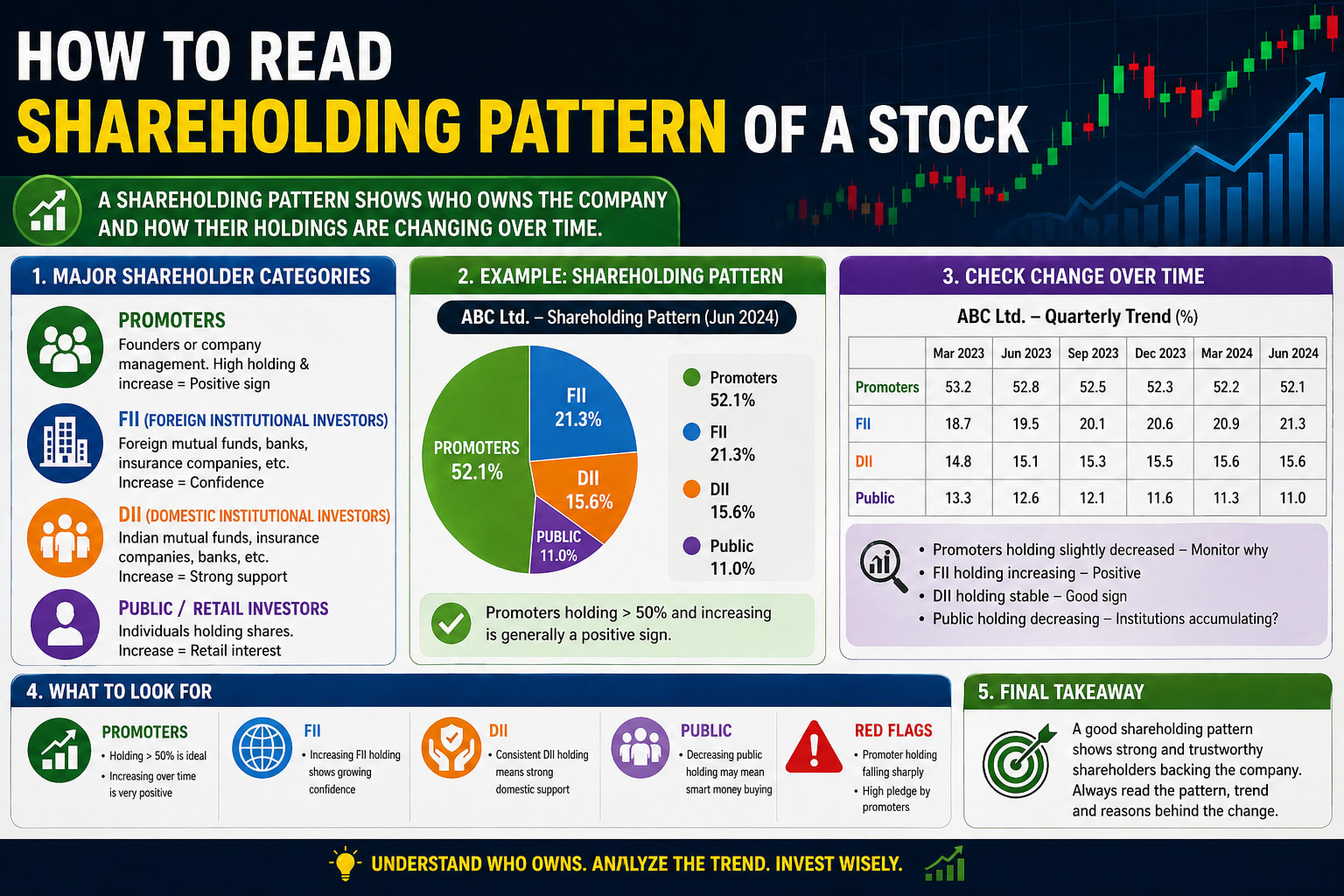
How to Read Shareholding Pattern of a Stock
A detailed investor guide to reading shareholding pattern of a stock, including promoter holding, FII and DII ownership, public participation, red flags, green flags, and how to interpret changes intelligently.
Table of Contents
Why Shareholding Pattern Matters for Investors
Many retail investors read shareholding pattern only to see whether FIIs or mutual funds increased their stake. That is too shallow. The real value lies in understanding what the changes mean in context.
For example, promoter holding stability may signal conviction, but a very high promoter holding with low free float can also make the stock illiquid. Rising institutional ownership can be positive, but it is not automatically bullish if valuations are stretched or the buying is too concentrated.
Shareholding pattern helps answer bigger questions:
- Is promoter skin in the game strong enough?
- Are institutions building conviction or reducing exposure?
- Is public holding becoming too speculative?
- Is ownership concentration creating liquidity or governance risk?
Main Ownership Buckets Explained
| Category | What it means | Why investors care |
|---|---|---|
| Promoters | Founders, controlling families, or management-linked owners | Shows control, conviction, and alignment |
| FIIs/FPIs | Foreign institutional investors | Signals global institutional interest |
| DIIs / Mutual Funds | Domestic institutions, insurers, and mutual funds | Shows local professional conviction |
| Public | Retail and smaller non-promoter shareholders | Can indicate participation breadth and speculative interest |
| Others | Corporates, trusts, alternative funds, etc. | Needs deeper context depending on the holder type |
How to Read Shareholding Changes Quarter to Quarter
1. Promoter holding
If promoter holding rises, investors often read it positively, especially if it comes through open-market buying or creeping acquisition. If promoter holding falls, ask why. A reduction is not always negative, but context matters. Was it for regulation, liquidity, debt reduction, or confidence loss?
2. Institutional accumulation
Rising mutual fund or DII ownership can signal improving conviction among professional investors. But do not treat every institutional increase as a buy signal. Sometimes institutions enter late, and sometimes the position size is too small to mean much.
3. Public holding
A sharp rise in public shareholding can mean broader market participation, but it can also suggest froth or crowding. If public ownership surges while institutions exit, that deserves attention.
4. Concentration and liquidity
Very concentrated holdings can create sharp price movements because free float is limited. That can help stocks move up quickly, but it also increases volatility and downside risk when sentiment changes.
Positive Signals in Shareholding Pattern
- Stable or rising promoter holding with clean governance history
- Gradual and broad-based institutional accumulation
- Mutual fund ownership increasing alongside improving business performance
- No signs of forced dilution or governance stress
- Ownership changes that support the earnings story, not contradict it
Green flag The best ownership changes usually confirm the business story rather than create it.
Red Flags to Watch in Shareholding Pattern
- Promoter stake falling without a clear healthy reason
- Heavy public participation while institutions quietly reduce exposure
- Very low free float causing unstable price action
- Pledged promoter shares
- Frequent dilution hurting minority shareholders
Promoter pledge deserves special attention. It can become a serious governance and financial-risk signal, especially in volatile markets. A great-looking business can still become a dangerous stock if promoter funding stress enters the picture.
How Investors Should Use Shareholding Pattern in Practice
- Check the last several quarters, not just one quarter.
- Read ownership changes alongside business performance and valuation.
- Study whether promoter behaviour supports management commentary.
- Use pledging, dilution, and concentration as risk filters.
- Remember that ownership data is a clue, not a standalone verdict.
How Bull Run Reads Ownership Signals
We use shareholding pattern as a supporting intelligence layer, not as a shortcut. Ownership changes matter most when they reinforce or contradict the operating story. Strong results with rising institutional conviction and healthy promoter behaviour can strengthen confidence. Weak results masked by narrative-heavy ownership excitement deserve caution.
The smartest use of shareholding pattern is not chasing “who bought.” It is understanding what ownership structure says about trust, control, liquidity, and risk.
Frequently Asked Questions
What is shareholding pattern in stocks?
It is the breakdown of who owns a company’s shares, such as promoters, institutions, mutual funds, and public shareholders.
Why is promoter holding important?
Because it shows promoter skin in the game, control, and alignment, though it must also be judged with governance quality and pledge risk.
Is rising institutional holding always positive?
No. It can be positive, but it must be judged with business performance, valuation, and the size and quality of the increase.
What is a red flag in shareholding pattern?
Promoter stake decline without clear reason, high public froth, pledging, repeated dilution, and weak institutional confidence can all be warning signs.
Should shareholding pattern be used alone for stock selection?
No. It should be combined with business quality, valuation, balance sheet strength, and earnings performance.