How to Screen Stocks by ROCE in NSE and BSE
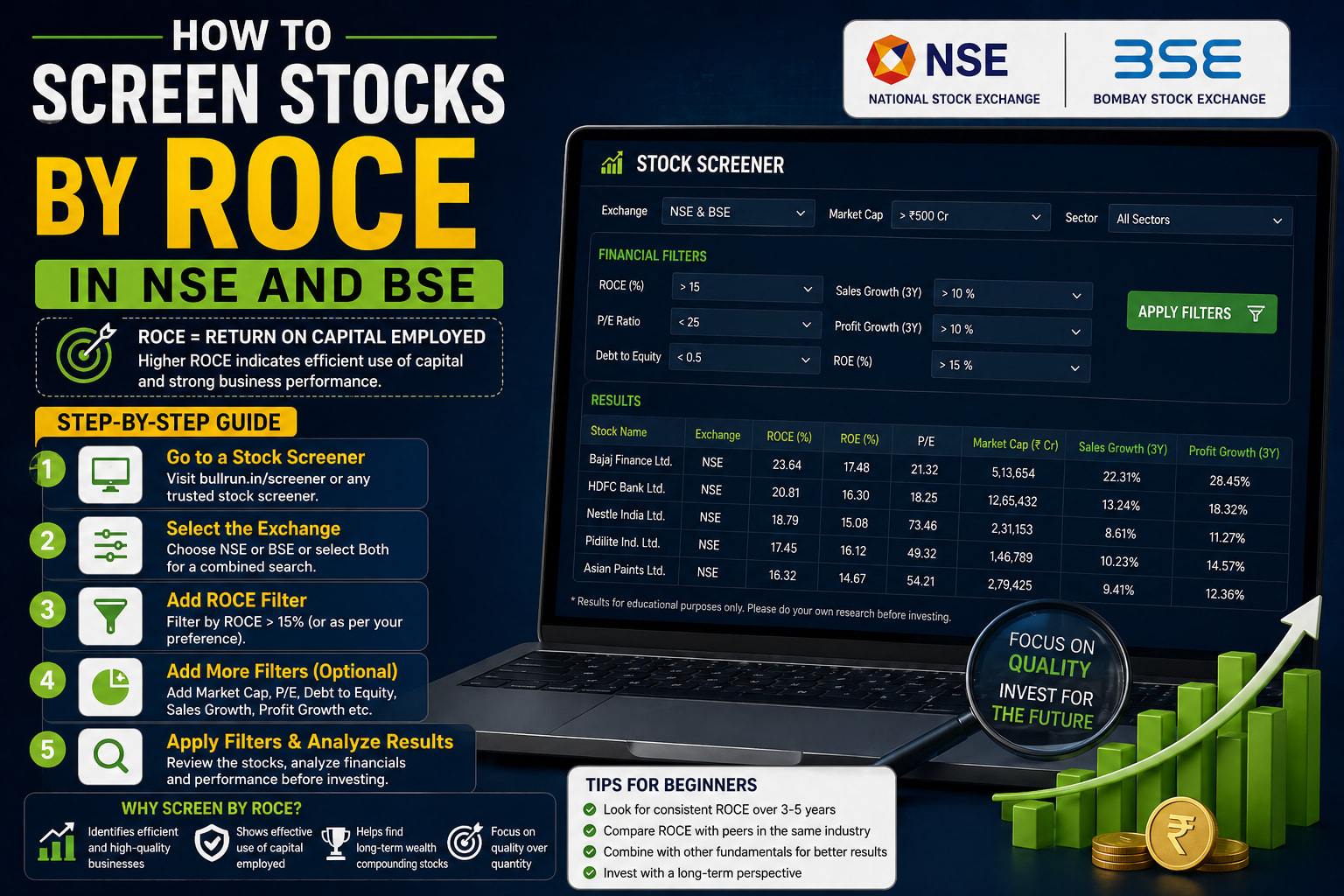
How to Screen Stocks by ROCE in NSE and BSE
A detailed Bull Run guide to screening stocks by ROCE in NSE and BSE, including what ROCE really tells you, how to use it properly inside a screener, what thresholds make sense, and where investors often go wrong.
Table of Contents
Why ROCE Matters in Stock Screening
ROCE, or return on capital employed, is one of the clearest ways to judge whether a company is using capital efficiently. That is why it is such a powerful screening ratio. A business can show growth, headlines, and market attention, but if it cannot earn respectable returns on the capital tied into its operations, the long-term compounding story becomes much weaker.
For Indian investors screening NSE and BSE stocks, ROCE is especially valuable in manufacturing, engineering, industrial, infrastructure, capital goods, and other sectors where assets and capital intensity matter a lot.
How to Screen Stocks by ROCE
The simplest way is to use ROCE as a quality gate, not as a magic prediction tool. Start by setting a minimum ROCE level that removes weak capital users, then combine it with a few supporting filters.
| Step | What to do | Why it matters |
|---|---|---|
| 1 | Set a minimum ROCE filter | Removes weak operators |
| 2 | Add debt discipline | Prevents weak balance-sheet stories from slipping in |
| 3 | Add growth filter | Separates efficient but stagnant businesses from scalable ones |
| 4 | Check cash flow | Ensures earnings quality supports the return ratio |
A screener built this way is usually more effective than a pure ROCE-only screen, because high ROCE on its own does not always mean strong future returns.
What ROCE Thresholds Make Sense?
There is no universal cut-off, but many investors treat double-digit ROCE as the minimum quality zone and stronger numbers as a sign of better economics. A business with 20 percent ROCE and improving trends usually deserves attention. A business with weak or falling ROCE usually deserves caution, especially if it still needs large capital investment.
What matters more than one fixed threshold is trend and sector context. A stable high ROCE over many years is far stronger than one random spike.
What to Combine With ROCE in a Screener
- Debt to equity: Strong ROCE with reckless leverage needs caution.
- Sales and profit growth: Helps you find businesses that are not only efficient, but also expanding.
- Operating cash flow: Keeps the screen grounded in earnings quality.
- Market cap or sector: Helps you focus the search where it makes strategic sense.
If your goal is to find high-quality compounding businesses, ROCE works best as part of a larger filter set rather than a standalone badge.
Mistakes Investors Make With ROCE Screens
- Using only one-year ROCE.
- Ignoring sector structure.
- Ignoring leverage.
- Forgetting valuation.
- Treating ROCE as enough on its own.
Best use ROCE is excellent for creating a better shortlist, not for making blind final decisions.
How Bull Run Uses ROCE in Screening
We use ROCE as a quality and capital-efficiency filter, especially in sectors where physical assets, working capital, and reinvestment discipline shape long-term outcomes. High and improving ROCE often points to stronger economics, but only when supported by clean balance-sheet structure and credible business execution.
That is why good ROCE screening should always lead to deeper business reading rather than quick conclusions.
Frequently Asked Questions
What is ROCE in stock screening?
ROCE is return on capital employed, a ratio used to measure how efficiently a company generates operating profit from the capital used in the business.
What is a good ROCE filter for screening?
There is no universal cut-off, but many investors use a decent double-digit ROCE as a starting quality filter and then study trend and sector context.
Should ROCE be used alone in a screener?
No. It works better when combined with debt, growth, and cash-flow filters.
Is ROCE more useful in some sectors than others?
Yes. It is especially useful in capital-heavy sectors such as manufacturing, industrials, engineering, and infrastructure.
Can high ROCE still be misleading?
Yes. High ROCE can mislead if it is temporary, not supported by cash flow, or accompanied by risky leverage or poor growth quality.