What Is ROCE and Why It Beats ROE for Capital-Heavy Businesses
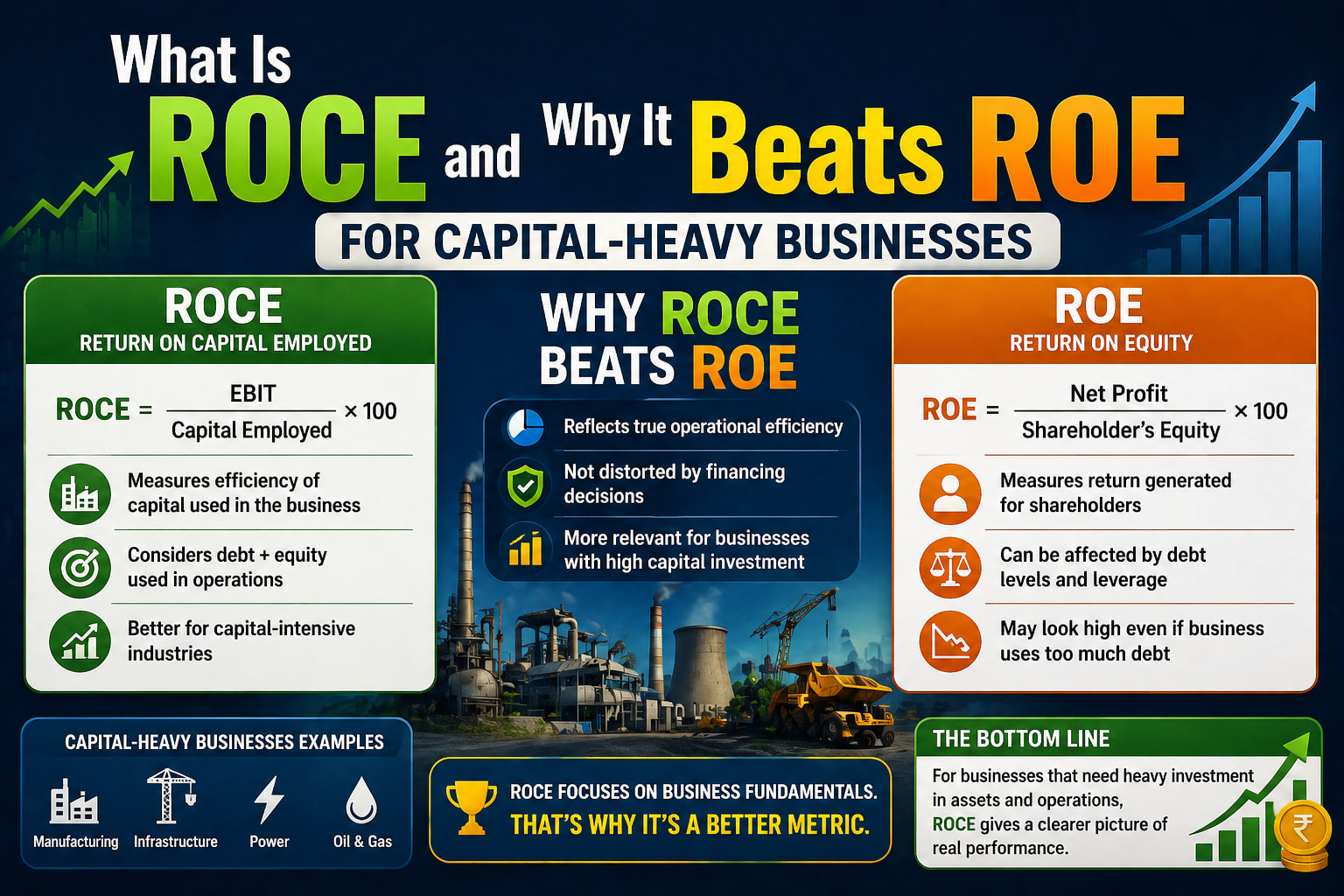
What Is ROCE and Why It Beats ROE for Capital-Heavy Businesses
A deep, practical guide to ROCE, how to calculate it, why it often beats ROE for capital-heavy companies, and how investors can use it to judge business quality more accurately.
Table of Contents
What Is ROCE?
ROCE stands for Return on Capital Employed. It measures how efficiently a company generates operating profit from the capital actually deployed in the business. In simple terms, ROCE tells you whether management is squeezing enough operating earnings out of the money tied up in plants, machinery, working capital, and long-term operating assets.
That makes ROCE especially valuable when you are analysing capital-heavy businesses such as manufacturing, cement, steel, auto, engineering, infrastructure, railways, utilities, telecom, logistics, or power. In these businesses, earnings are shaped not just by demand, but by how much money the company had to lock into factories, equipment, distribution, maintenance, and working capital to generate those earnings.
Why ROCE Often Beats ROE for Capital-Heavy Businesses
ROE is popular because it looks clean and easy. It tells you how much profit a company earns on shareholder equity. But in capital-heavy businesses, that can be too narrow. Many asset-heavy companies use a mix of equity and debt to fund large physical operations. If you look only at equity, you may miss the real economic burden of running the business.
ROCE is often superior here because it asks a tougher question: how good is this business at earning returns on the full capital base required to operate it? That includes both equity and debt-linked operating capital. A factory does not care whether the money came from shareholders or lenders. It still has to earn enough operating profit to justify the capital locked inside it.
Why this matters in real life
- A business can show a decent ROE simply because equity is small and leverage is high.
- A business can look attractive on EPS growth while still destroying value if capital needs keep rising too fast.
- A company with improving ROCE often signals stronger pricing power, better utilisation, smarter expansion, or tighter capital discipline.
Practical truth In asset-heavy sectors, ROCE usually tells you more about business quality than ROE alone.
How to Calculate ROCE
The standard formula is:
| Metric | Formula | What it tells you |
|---|---|---|
| ROCE | EBIT ÷ Capital Employed | Operating return on total capital used |
| EBIT | Earnings Before Interest and Tax | Operating profit before financing effects |
| Capital Employed | Total Assets − Current Liabilities | Long-term capital tied into operations |
Suppose a company earns EBIT of ₹500 crore and uses ₹2,500 crore of capital employed. Its ROCE is 20 percent. That means the company is generating ₹20 of operating profit for every ₹100 tied up in the business.
This is why ROCE is useful: it strips the focus back to operating economics, not just bottom-line optics.
Where ROE Can Mislead Investors
ROE can still be useful, but it has blind spots. In capital-heavy businesses, the biggest issue is that ROE can be boosted by leverage, write-downs, buybacks, or a shrinking equity base. That means a company may show a healthy ROE while the real operating return on capital remains mediocre.
Common situations where ROE can deceive
- High leverage: Debt reduces the equity base, making ROE look better than the core business really is.
- Cyclical peaks: Temporary earnings booms can inflate ROE, especially in commodities or industrials.
- Accounting effects: Write-offs or reduced net worth can mechanically lift ROE without improving the business.
- Capital expansion mismatch: The business may raise huge capital for future projects, but current ROE may not capture the true economics well.
ROCE handles these situations better because it forces you to assess return against the broader capital footprint of the business.
How to Read ROCE Properly
A high ROCE is good, but context matters. A 22 percent ROCE in a capital-heavy business can be outstanding if it is sustainable. A 12 percent ROCE may be acceptable in a difficult regulated sector. What matters is consistency, direction, and whether the company earns above its cost of capital over time.
What strong ROCE often signals
- Healthy asset utilisation
- Operational discipline
- Better pricing power
- Smarter capital allocation
- Strong execution in expansion projects
What weak ROCE can signal
- Idle capacity
- Poor project economics
- Heavy capex without matching earnings
- Working capital stress
- Weak competitive position
Important A single-year ROCE number is less useful than a 5 to 10 year trend.
How Investors Can Use ROCE in Practice
- Start with sector logic. ROCE matters most where assets and capital cycles are central to the story.
- Compare long-term trends. A rising ROCE trend usually matters more than one headline number.
- Check expansion quality. If capex is rising, ask whether ROCE is holding up or collapsing.
- Use ROCE with debt and cash flow. A good ROCE with reckless leverage still needs caution.
- Study peer comparison. In the same industry, higher and more stable ROCE often points to stronger economics.
For a capital-heavy company, ROCE is one of the most revealing quality filters available to investors. It helps separate businesses that merely consume capital from those that actually compound it.
How Bull Run Looks at Capital Efficiency
When analysing industrials, manufacturing, engineering, utilities, and infrastructure-linked names, we prefer to start with operating economics rather than surface-level earnings excitement. ROCE helps reveal whether management is building a business that earns meaningfully on the capital it absorbs.
That does not make ROE useless. It simply means ROE should not be allowed to dominate the conversation in businesses where assets, capex, and leverage shape the real economics. In those cases, ROCE usually gives investors the cleaner lens.
Frequently Asked Questions
What is ROCE in simple words?
ROCE measures how efficiently a company generates operating profit from the total capital employed in the business.
Why is ROCE better than ROE for capital-heavy businesses?
Because ROCE evaluates returns on the full operating capital base, including debt-supported capital, while ROE looks only at shareholder equity.
What is a good ROCE for a company?
A good ROCE depends on sector economics, but a sustainably high and improving ROCE is usually a strong sign of business quality.
Can a company have high ROE but weak ROCE?
Yes. This can happen when leverage is high or equity is small, making ROE look stronger than the underlying business economics.
Should investors use ROCE alone?
No. ROCE should be combined with debt, cash flow, capital allocation, growth quality, and sector comparison.